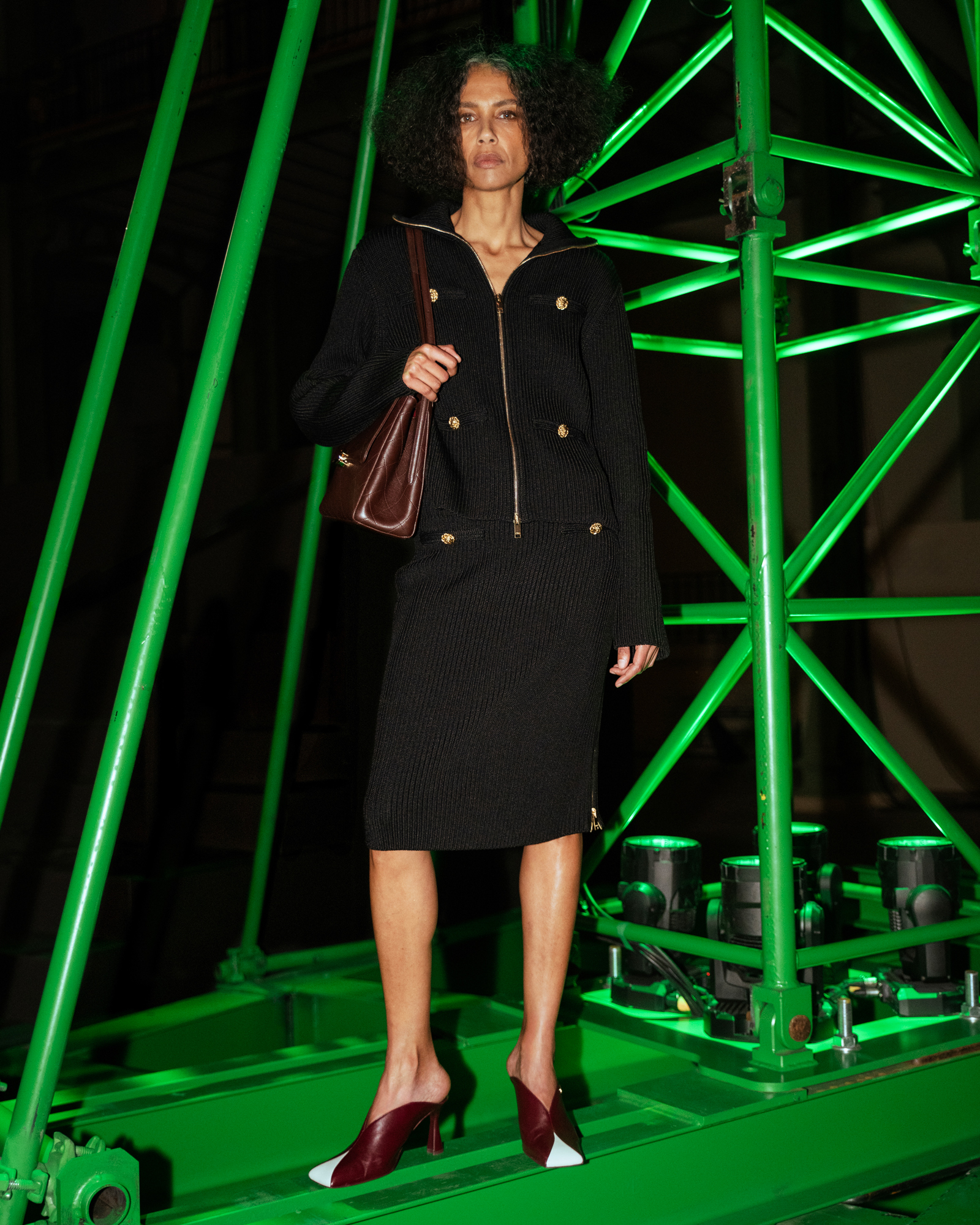
Photography by César Segarra for S Moda for El Pais | Image courtesy of IconicFocus Models (New York)
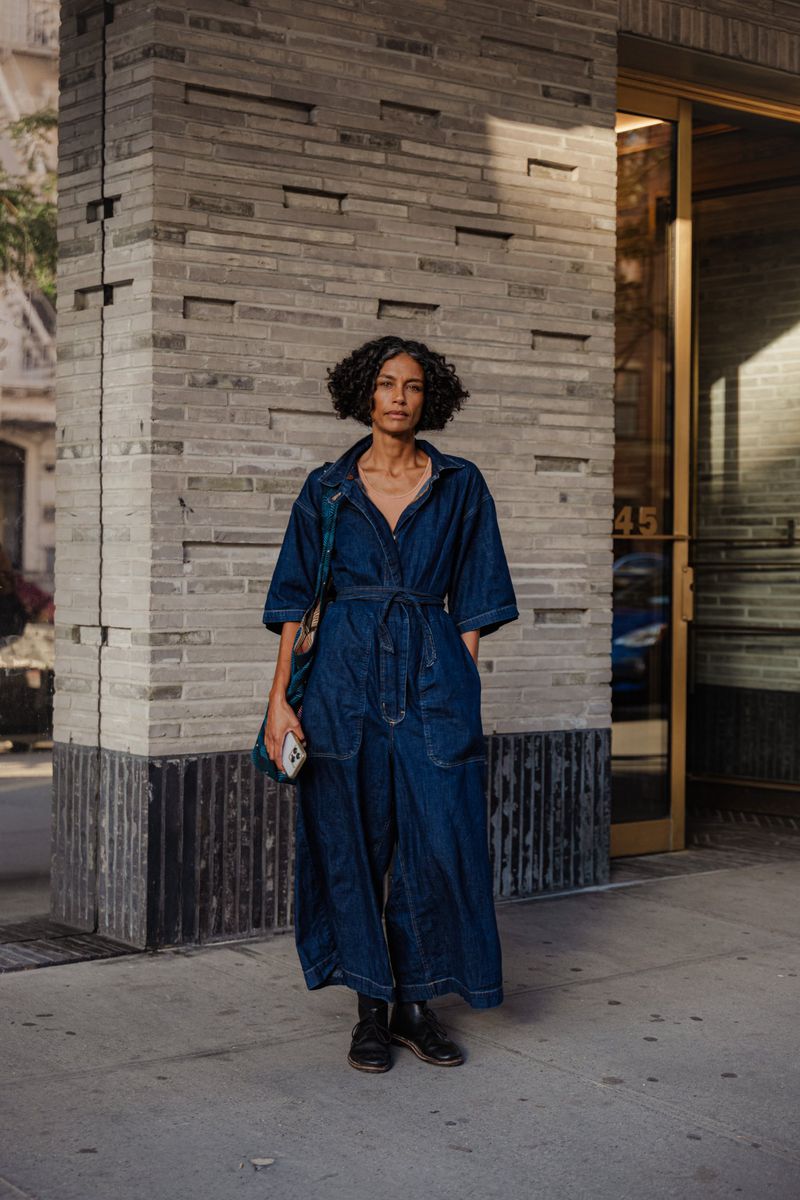
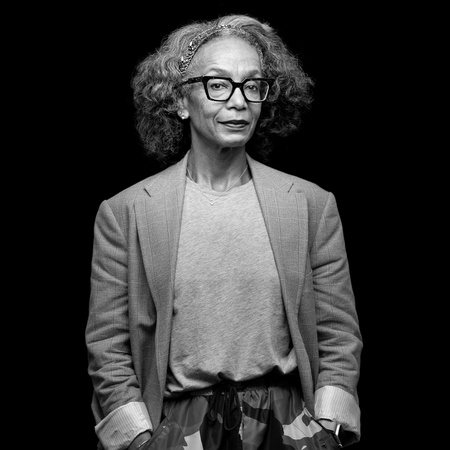
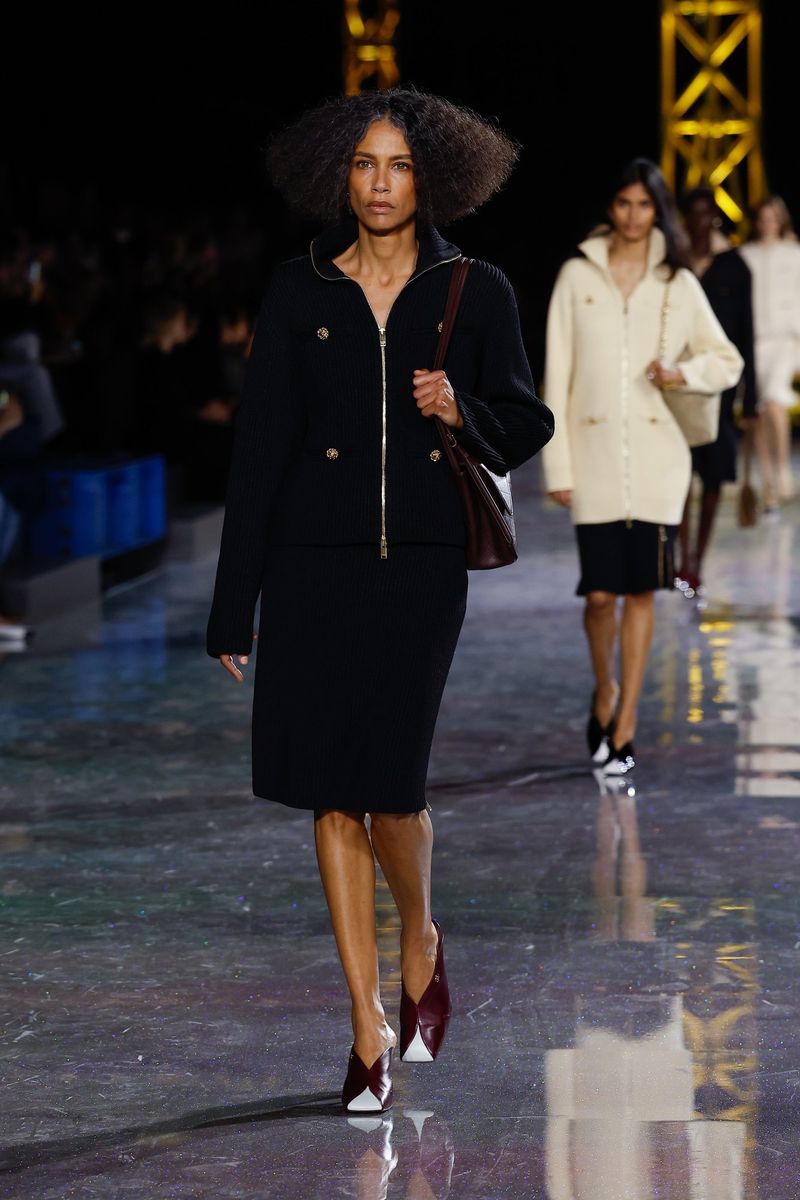
Elongated cranes of primary colors decorated the Grand Palais in Paris as the sounds of Cesária Évora’s voice blended seamlessly into Molly Lewis’ whistle, echoing across the museum. It was the last rollout of Chanel’s Fall/Winter 26 Collection at Paris Fashion Week and a further glimpse of Matthieu Blazy’s imagination. Since taking the reins at the fashion house, one of the most enigmatic aspects of his era at Chanel has been his use of mature models, one of whom stands at 5’8” and sports a salt-and-pepper bob. Nearly 50, Stephanie Cavalli opened Chanel’s A/W 26 Show fresh on the heels of opening the Spring Haute Couture Show in January. With a career that has spanned two decades on and off, the Guadeloupean-Italian model now serves as a quintessential reference for this era’s Chanel woman; a woman who has lived, and it’s reflected in the garments.
In the late 90s, Cavalli was studying foreign languages at the University of Rome in hopes of becoming a book translator when a friend asked her to be one of his photography subjects. Nothing came from the portraits until he called once more and then introduced Cavalli to her first agency. From then on, she pursued a career in modeling, which led her to Brooklyn, where she took on commercial projects. However, in her mid-thirties, when she was considered both too young and too old for clients, Cavalli left the industry behind. However, nearly three years ago, Cavalli debuted on the runway, and soon after began appearing in runway shows for Rachel Comey, Proenza Schouler, and Miu Miu. Born in Ostia, a small town outside of Rome, she now lives between Rome and New York, where, as noon approaches, Cavalli has just sent her son off to school. Later on in the day, she’ll head out for a fitting. Models.com contributor Nia Shumake spoke with the emerging runway model on her career, beauty, and her fascination with Goliarda Sapienza’s The Art of Joy as a reference for life.
Growing up in Italy with a Guadeloupean background, how did those different cultural references shape your idea of beauty?
Both of my parents had an idea of beauty, but they were each very different. My mom was into nature, animals, and life. She was a midwife and was interested in birth and the harmony that life has in its forms, whereas my father loved art and antiques. He loved flea markets and would find old trinkets, collectibles, and watches, then bring them home. These two different approaches shaped the way I see beauty now, because I see it in what’s harmonious from nature to art, and it creates an emotion.
How did Ostia differ from Rome culturally, and how did that contrast shape you?
I grew up in the 70s and 80s, so my particular neighborhood was harrowing with delinquency. It was very rough and I had to defend myself from what was out there, but I wasn’t suffering. There’s an old movie from the early 80s on Ostia, Amore Tossico by Claudio Caligari and it’s about heroin addiction during that time period. I was about six or seven years old then. That movie says it all. Rome was the city with glitz and glamour, whereas Ostia was darker. There were heroin addicts walking the streets while we were kids, and once we got into our teenage years, it became more political. There was a fascist side. Ostia was filled with occupied centers called “espacio camino,” which meant a fireplace space. That was where I found my people. I grew up on one side and you had to be careful where you walked on the street because people sometimes yelled at you. On the other side, there was an enclave of people who were nice, funny, and welcoming. They taught me to brush the assholes off my shoulder. Ostia is now more diverse, which I love to see when I go, but I can see there are still many integration problems among people. In elementary school, I was the only black person, or person of color in school. While I’m mixed, my mom is Black and moved to Italy working as a midwife in a clinic. She was the only Black person working in that clinic. It was more intense for her than it was for me. I still have beautiful memories of my childhood, because we had the beach and on Sundays, the center of our world. I think both the glitzy city life and the frontier kind of living shaped me.
Was modeling always the plan, or did you ever envision a different path?
I did not think about modeling until I was 21. I had a friend who wanted to become a photographer and took a couple of pictures of me. I attended the University of Rome and got my degree in foreign languages because I wanted to work as a book translator or in book editing. That was the initial plan, but it took me longer to graduate because I was modeling. Although I did translate a couple of books.
Who were your favorite models and inspirations?
Kristen McMenamy was super cool. During the 90s, she had an androgynous, extraterrestrial look that I really liked. She had character. Every time I look at beauty, the character has to come through. I always thought that Erin O’Connor was extremely elegant, and I love pictures of Kate Moss when she’s wearing very little makeup. You can see her wrinkles and expressions. I’ve always been in love with Anna Magnani, an Italian actress from the 1950s-70s. She was handsome and strong. I like life behind the eyes, and when I see that, it’s what inspires me the most.
How did you first get discovered?
My friend, who wanted to become a photographer, eventually became one [in the early 90s]. At the beginning, he was just starting in Milan. He called me for a photo shoot once, and the second time I went, he introduced me to the person who would become my mother agency for a while. From then on, I went to Ford’s Supermodel of the World contest. I spent a week in Beijing with my agency, and that’s how I got in contact with my other agencies in Paris, Vienna, Germany, and in the States.
What event pushed you to move to New York City? What was life like for you once you made the move?
I was going back and forth. I did a couple of months here and there. I liked it, but I wasn’t particularly impressed, and then I met somebody and decided to stay for a while. I said I was going to stay for a couple of years and see what happens. I ended up staying longer. I knew a few people, and they were ultimately the people that I was going to end up hanging out with. My boyfriend at the time was American and spoke Italian too. We had a pretty big group of Italians and Germans, and we spent almost every day together. I remember bicycling around Brooklyn on weekends and going to parties and rallies together.
You’ve mentioned that in your thirties, you were considered both too young and too old. When did you decide to halt that part of your life, and what ultimately drew you back?
I had my second son and stopped coloring my hair for that pregnancy. When I got back to work, the agency looked at me a little funny, but they didn’t say anything. They took some pictures, and then came back to me a few days later, and said, “The clients see a few grays.” I did end up coloring my hair, but in that moment, something inside me was proud of my little grays and liked my hair that way. I wanted to feel like I wasn’t that young girl anymore and that I was evolving into something else, and I wanted to give a real image to the person that I felt I was becoming. But that wasn’t allowed, so I started coloring my hair again, using Brazilian Keratin, but it wasn’t authentic. I was trying to look 31, because looking 38 wasn’t good. I noticed that it wasn’t working, and I decided, okay, this is the end of it. That’s when I started my business as an antique dealer, but not seriously. I was just looking for what fascinated me. I started selling at the flea market in Brooklyn. Then from there, I started doing the Manhattan Vintage Show, because I started to get into clothes. After the shows, I opened my shop in 2019, and around the same time, I started modeling through another photographer, Bill Westmoreland. He asked me, “Why don’t you try again?” Bill put me in contact with Iconic Focus, which is now my mother agency. During the pandemic, I stopped coloring my hair and let it grow out, and I noticed that it worked, so I rode the wave.
When you opened up your vintage shop, La Garconne, how did your work as a muse ultimately impact your eye for tasteful garments?
It helped me broaden my vision, seeing infinite possibilities within one garment. That came from working in fashion and observing how stylists would put things together in unexpected ways. It has influenced me when I choose something for my shop. It’s not only the look of garments, but the craftsmanship, draping, and intention that comes from working closely with clothes.
The Art of Joy by Goliarda Sapienza profoundly impacted the way you approach life. What was life like before the moment you read it, and then how did you approach life afterward?
I think that the change was already happening, but right in the moment, the book came to me in a serendipitous way. It tells the narrative of a woman from her birth up until her 60s, and the book doesn’t end with her death. The book has the best ending, and its last sentence is absolutely fantastic. It’s full of hope. It’s about this woman who is fascinating because she’s herself all the time. She’s an affectionate mother, but she’s also a Machiavellian idealist. She’s a lover of both men and women. She’s immoral to society, but also uses society to be where she is. She’s a woman with all her defects and qualities that create this full life. And it’s very hopeful, because it kind of makes me look at my own shortcomings as part of me. There is a moment where the woman says, “ At 50, I thought that my life was going to be settled and done and that I was going to be a finite human being, and instead, there’s still so much more and life is still bringing me more.” I want to have that look towards life. I don’t want to feel like “Oh my God, I’m turning 50! Oh my God, I’m turning 60!” I want to fight that and it’s hard because many of us were brought up thinking about aging as negative and being told that when you get older, you get tired, bitter, and that real life happens during youth. I am discovering how, for so many things, I am a happier human being now than when I was 20. I want to keep this hope. I want to keep this curiosity because once you don’t have any hope or any curiosity, then life starts becoming gray. It’s really up to us to keep curious and hopeful.
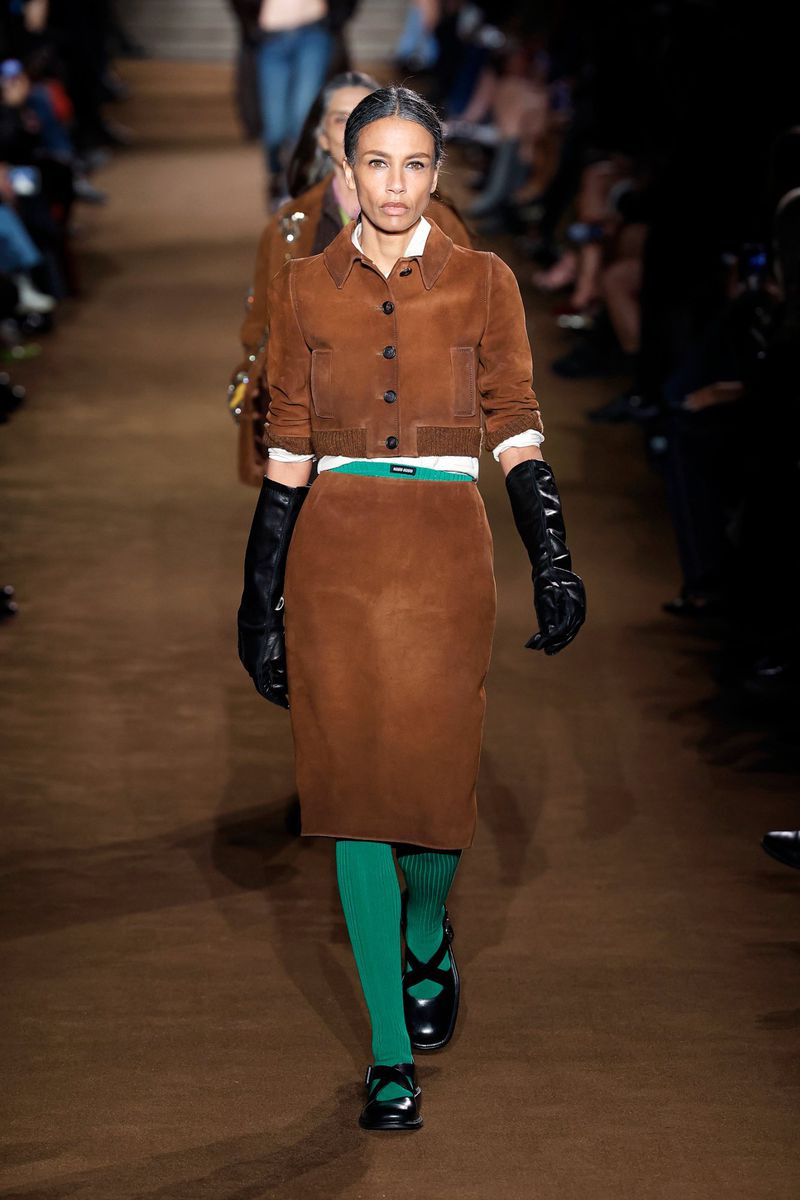
Let’s talk about embracing the gray—modeling is typically associated with youthfulness. Were you at all hesitant about how changing the color of your hair would affect opportunities, or did you believe that it would cause you to stand out even more so?
I started during the pandemic. When I stopped modeling, I started shaving my head, and for a while, it was so short I didn’t need anything, so I let it grow a little bit. Then, when I decided to let go of the shaved head, that’s when I started to let go of covering the gray. It happened naturally. I’ve noticed that my hair is much healthier and I like to think that when I started acquiring self-confidence, the work started. I think it has a lot to do with luck. I was at the right place at the right time, and I didn’t have any certainty that it would work. I didn’t think, “Oh, this is a good move and it’s going to work and people are going to appreciate it”. The mentality is changing and it might change again, but now is a good time. It’s definitely planting a seed for bigger changes ahead.
What made you make the leap between commercial modeling and runway? Outside of the more obvious reasons, what differences do you think would surprise most people?
It just happened. Commercial modeling is very different from runway modeling. High fashion allows more creativity and personality to come through. Whereas in commercial fashion, you follow more guidelines and have to be very careful. The clothes need to look perfect. There’s not one wrinkle that can be imperfect, and you always have to give the same smile. High fashion is more difficult because you have to let go of the prepackaged thing, and you have to show more of yourself, which can be challenging. We all have our insecurities, but ultimately, I noticed over the year that the more you have fun with it and let go of all the stupid things you believe about yourself, the less self-conscious you are, and that helps a lot in the process. With high fashion, you really feel like you’re part of a story.
Do you utilize research at all in your work as a model? I’m particularly interested in how you developed your runway walk.
It’s generally more related to the kind of client, and I research minimally. I look into clients and into photographers, and they get a general vibe, but I don’t want to obsess over anything because I cannot be something else. I cannot walk like somebody else. My walk kind of interprets what I’m wearing at the moment.
Let’s talk more about your work with Matthieu Blazy. What was the process of being cast for Chanel the first time in the Métiers d’art show in New York?
Well, it was a very regular casting. My agent called me a couple of weeks before and mentioned that they wanted to see me at a casting. I was nervous, but I went. I did the casting, waited in line like everybody. He made me walk twice. I got out of there, and two hours later, I was in the car with a friend of mine, and I was told I’d been confirmed for Chanel.
What was your immediate response when you discovered you booked Chanel’s most recent show as an opener again? Did preparation look different for you?
I thought Oh my goodness, what’s going on? And by the second time, I could not believe it, because I had opened and checked the time before, so I was not expecting it at all. I was elated, but preparation was pretty much similar; I had one less layer of anxiety because I had done it before.
How has modeling shaped your relationship with your body over time?
Because people were judging me, it eventually wore me out, and that’s when I needed a break. It’s when I started thinking, this is not good enough, this is not pretty enough. There was a time when I was considered too thin, and it was continuous. I have to say that I’m much happier now. I let go of those impossible goals, and I do my yoga practice every morning because it makes me feel good about my body without the idea of sacrifice. Yoga is about strength and flexibility, which is what I need in general in life. My body’s changing, and I’m going to be 50 in a few months, but I don’t know. So far, I’m happy.
Your career has spanned over two decades. What mantra has kept you grounded?
Everything changes, and nothing stays the same. We should just be part of the change and accept it, which means that when there is a wave to ride, let’s ride it. When something happens, it eventually goes away because time changes everything. What’s important today won’t be important tomorrow. The idea that everything passes and everything changes is kind of a consolation to me in good and in bad, that things change. It’s dark, but eventually I won’t even be here. One thing that my agent said a while ago was that, in a hundred years, this will all be dust. Franco Battiato sings a song called Siamo Solo Di Passaggio, and it simply says that we’re just passing through.