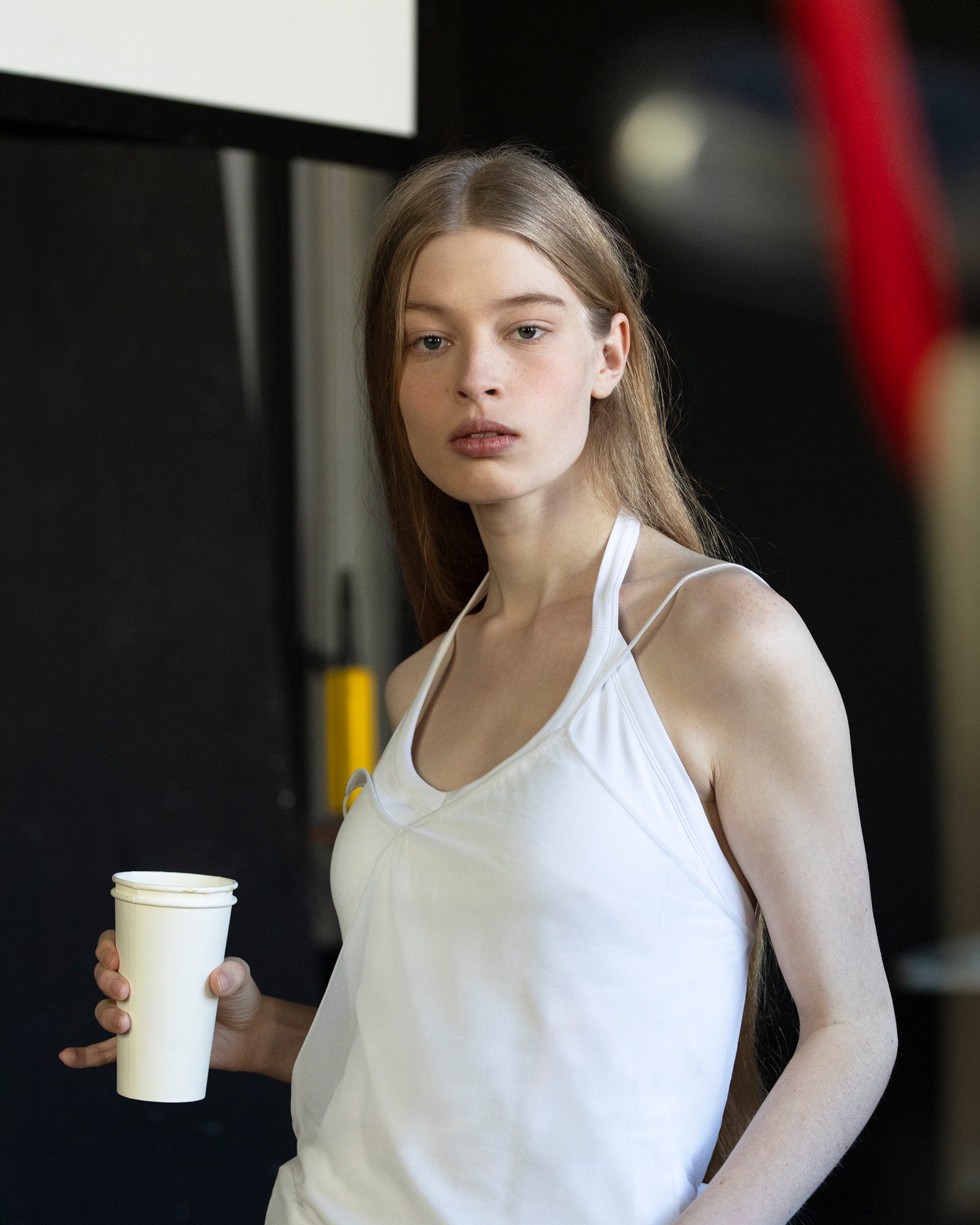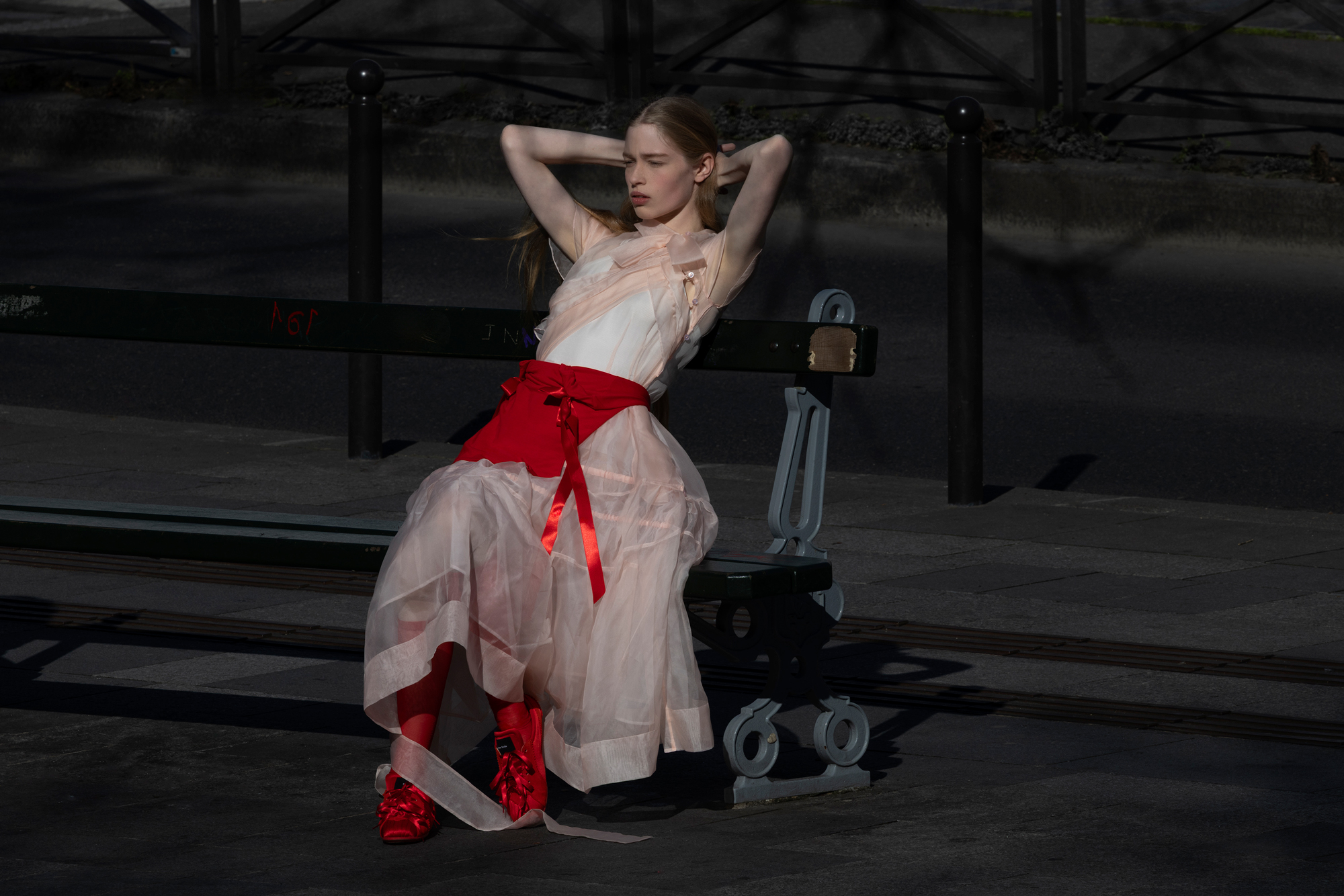
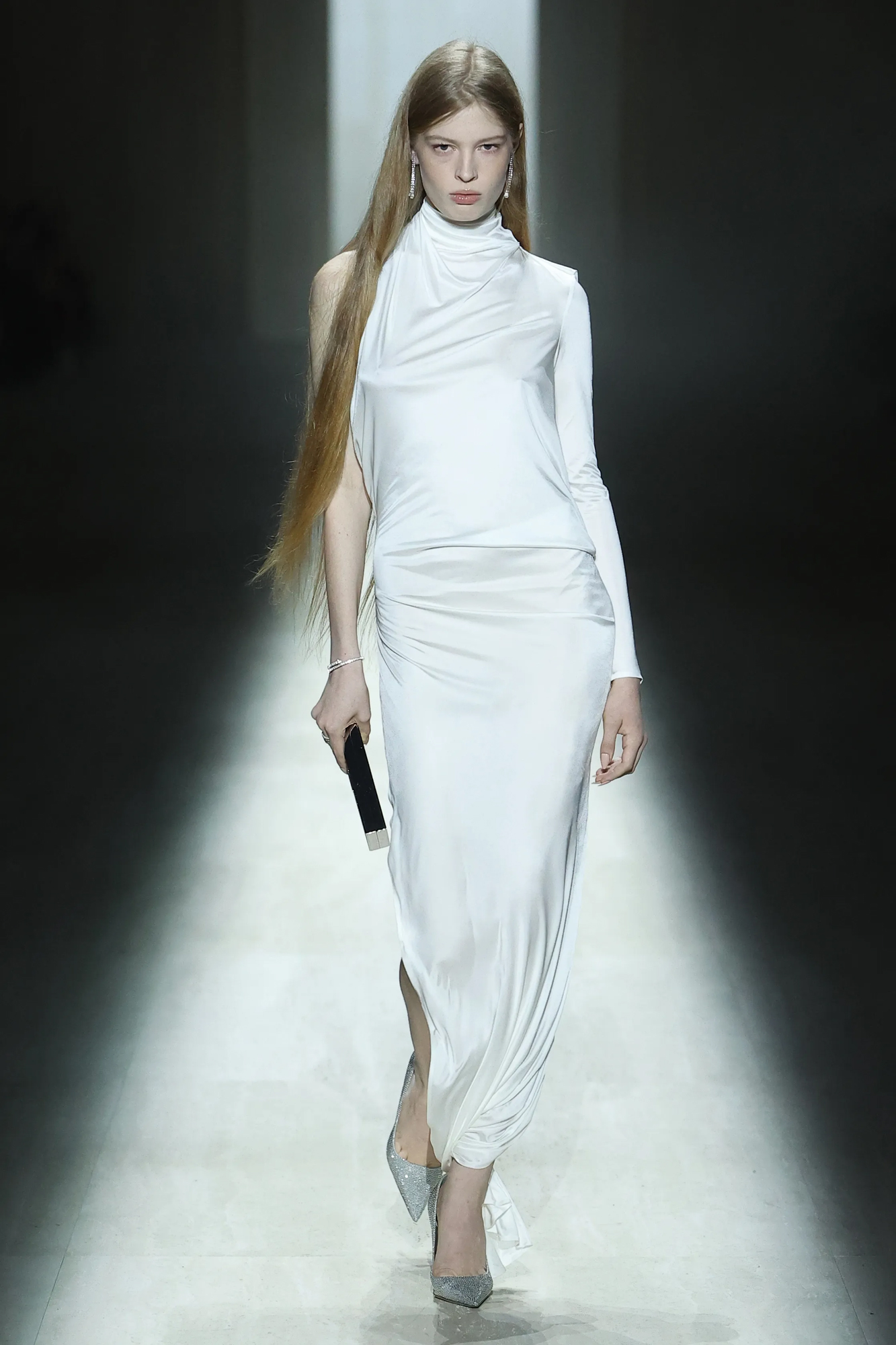
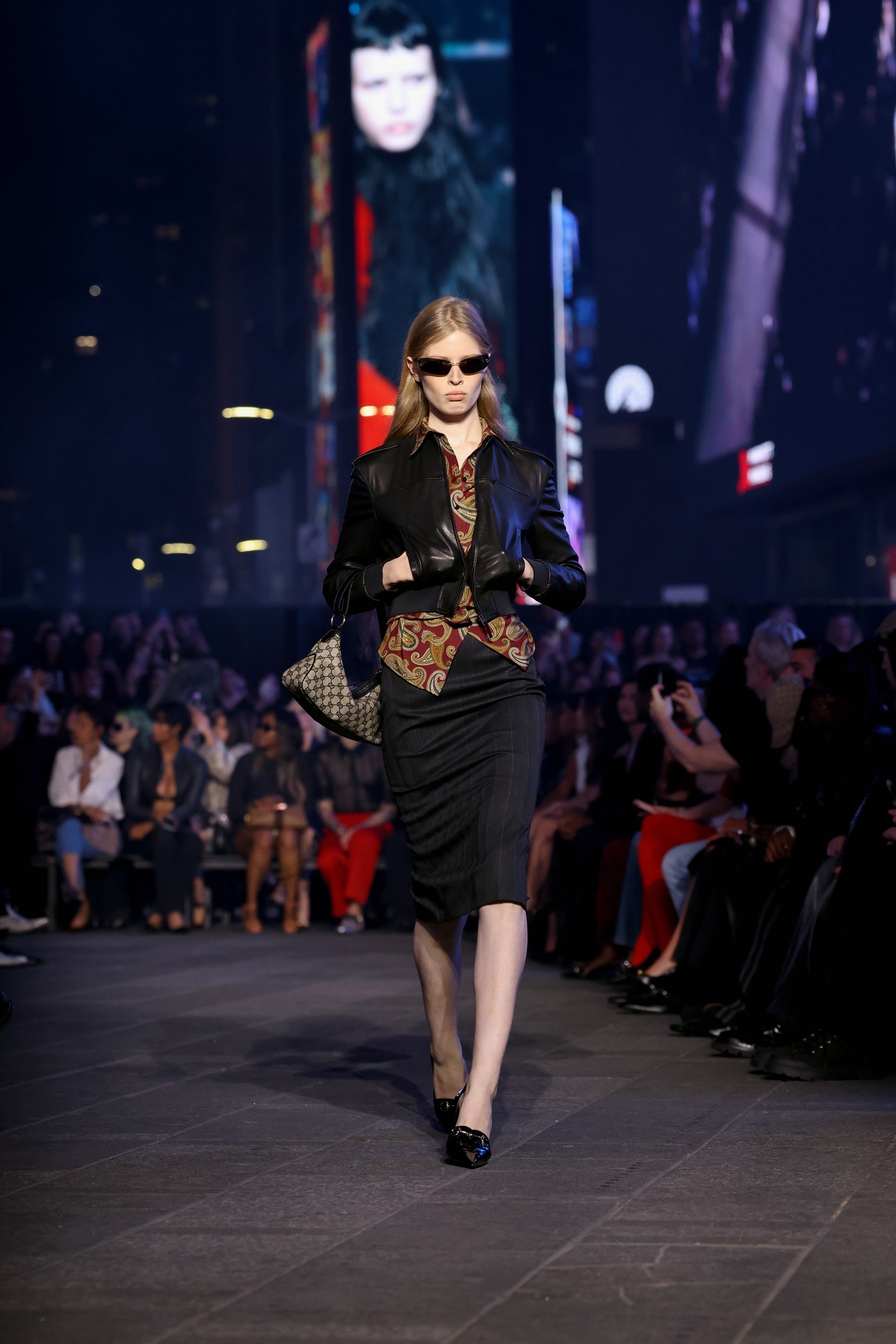
Vivian Wilson doesn’t approach modeling like someone cautiously testing the waters. She approaches it with the necessary enthusiasm and tunnel vision that can’t help but beckon the spotlight. Since making her runway debut less than a year ago, she’s already walked for Gucci, Alexander McQueen, Prabal Gurung, and Alexis Bittar, all while openly declaring on Instagram, “I will become a supermodel because I am insane.” Part joke, part manifestation, it’s entirely reflective of someone who understands that ambition is as much a mindset as it is a career strategy. Fashion, in turn, has embraced Wilson with remarkable speed, recognizing not only a compelling runway presence but a new generation of talent reshaping who gets to occupy the industry’s most visible spaces. Long before stepping onto a runway, Wilson had already built an audience online through her sharp humor, internet fluency, and a willingness to speak candidly about the cultural and political conversations shaping her generation.
As a proudly trans woman, she’s become part of a broader movement pushing fashion toward greater visibility and representation while refusing to let that identity define the entirety of her work. Never afraid to challenge the increasingly influential worldview championed by some of Silicon Valley’s most powerful figures, she’s cultivated a public voice that feels both self-aware and distinctly her own. That same confidence carries into fashion, where personality has become just as compelling as a runway résumé. Raised on RuPaul’s Drag Race and a handful of fashion magazines, Wilson speaks about modeling through the language of performance, memes, and Ballroom 101 as readily as she does castings and campaigns. In conversation with Models.com Editorial Director Irene Ojo-Felix, she discusses why becoming a supermodel means more than booking the biggest shows, the influence of drag on fashion, balancing life as both a creator and model, and why she’s determined to build a career on her own terms—with just enough delusion to make it happen.
Many people discover fashion through magazines or runways. What was the moment that made you think, “I actually want to be part of this industry?”
It was RuPaul’s Drag Race. I was in high school when I watched it for the first time, and I got obsessed with the show. My favorite part of every episode was when they would walk down the runway. So I’d just walk around with my music in my ears, pretending I was on the Drag Race runway. My mom was convinced. She said, “You’re going to be a model.” And I said, “There’s absolutely no way.” And then she was right.
It makes sense, considering drag and ballroom were fashion’s first movement directors. The influence on Madonna’s “Vogue,” Mugler, McQueen, Gaultier. It’s all there.
Absolutely. It’s kind of insane how far ballroom culture from 1980s Harlem has spread out and influenced so many different things.
I remember Prabal Gurung being an early runway moment for you last September. What do you remember about it?
Well, my first runway show was technically Alexis Bittar. I’m really glad that was my first. There were six of us, and we were all trans, which I’m really grateful for. My first runway experience was with other people who were also trans, so there was that added sense of camaraderie, of “we’re all in this together.” Everyone killed it. We did the show six times because they would cycle the audience in and out, and I remember gaining more confidence each time. At first I was really stressed and nervous that I had to go through it six times in front of a new audience, but I think it ended up being very beneficial to me. Prabal, I found out the same day. That was chaos. Really fun, though. We were just running around New York trying to get everything ready in time.
Your Instagram bio says, “I will become a supermodel because I am insane.” Now that you’ve walked for Gucci, McQueen, and Prabal Gurung, has your definition of becoming a supermodel changed at all?
I put that up a few months ago. Before that, my bio was “professional ageless celebrity,” and every few months, or when something big would happen, I would change a letter and not tell anyone. It got to E or D before people started catching on, which was really fun. But I didn’t think it fit me anymore, so I changed it. I was like, “Yeah, I’ve been saying I’m going to be a supermodel. Deal with it.” The term supermodel, to me, means one of the all-time icons. When I think supermodel, I think Naomi Campbell, Tyra Banks, Cara Delevingne. Cara said this as well: supermodels are defined not just by the success but by the perception around them. And that’s changed so much over time. So whatever the definition shifts to, I would like to become it regardless.
That’s a good manifesting spirit.
We’re manifesting. There’s nothing wrong with manifesting her. You have to be kind of delusional to make it.
Fashion week can be physical, technical, and weirdly mental all at once. What have you learned about the craft of walking? Not just looking great, but pace, posture, presence.
My agency in France did runway training with me, and that was really fun. I love runway training, with the book on your head, the whole thing. It’s a vibe. I find there is such whimsy in preparing for the runway.
Some models compare it to etiquette training.
I kind of see the resemblance, but etiquette training is way harder. I had to do a little of it when I was little and I hated it. I was so bad. I see how people think it’s like that, but personally, I think of it more like a dance class than etiquette.
Los Angeles has a reputation for reinvention. New York has always been presented as its foil. How has living in LA shaped the way you think about fashion and self-expression?
A lot of people think I live in New York. I keep getting invited to stuff there. It’s a fun city, I really like it, but I don’t live there. And New York and LA kind of are foils of each other. Los Angeles is warm, it’s kind of welcoming, but people are kind of mean, which is actually very New York as well. It’s still a major city, but there’s generally more laid-backness, less anxiety with every walking step, in terms of the culture.
Stylistically, there’s a huge difference between LA and Europe. When I went to Paris, the first thing that shocked me was, “Why is everyone in black?” In LA, all-black is common, but it’s not every outfit you see outside. Whereas in Paris, or in Germany, people don’t like color, I’ve noticed. Fair enough. Black is the most stylish, most all-encompassing color, and it inherently matches itself. So, I get it.
And I do think that LA vibe comes out in your personal style. You just were in Spain with Desigual, which was so bright and vibrant.
I love that outfit. It was really fun. I remember the whole time thinking, when I put it on, “Wow, I look amazing,” and, “Oh my God, mosquitoes are about to make a meal out of me.” Thankfully, that did not happen. But I’m tasty, apparently. Mosquitoes love drinking my blood.
You sit in this interesting crossover of content creator and model. Do your online instincts make you bolder in front of the camera, or do they create a whole different kind of pressure?
At the start, it was definitely an added pressure. Since I already had a platform, I was really nervous, because I was aware there would be eyes on me from the get-go. Now, well, I’m not on social media as much anymore; I should probably post more, to be honest. But I do think it has helped, mostly in the camera-presence department, and because you get so used to having people watch you. Where it hurts is that all of those times, it’s been in front of a camera you set up, where you control the timing. Runway, you show up rain or shine, in sickness or in health. I mean, it’s not supposed to be in sickness, but the show is going to happen. The lead-up is so different. I’d built up this whole process in my mind of getting my own camera set up, and it’s literally my phone, girl. That was so pretentious. But yes, I have my own process for runway too. It’s just very different.
Is there ever pressure to constantly capture what you’re going through? Or moments where you think, “Maybe I shouldn’t film this”?
Yeah, and I don’t film those things. I agree with Doja Cat on this: there are aspects of my private life that are private and that people don’t need to be concerned about. Most of the stuff I post is just random things I think people would find interesting, or that I find interesting. I do think it’s important for public figures to have a private life. Y’all don’t need to know about it!
Has fashion ever felt less open to you being yourself online?
My personality can be a little extra, and I have been nervous that it would drive people off. But I do feel like it has also made me more responsible on the internet, and I think that’s a good thing. It’s not fully negative, not fully positive.
You’ve spoken about wanting to carve out your own path. As your profile grows, how do you make sure you’re building a career defined by your own interests rather than other people’s expectations? What’s next?
I always have plans, schemes, and machinations, so perhaps you might just need to find out. Come along for the ride.
Fashion Week is right around the corner. Is there a house you haven’t walked for yet that you find yourself thinking about?
There was one, and I still really want to walk it. Do I say it? Oh my God. I don’t think it’s going to happen, but I’m really quite fond of Schiaparelli.
PG is always on Models.com. I hope it happens for you!
Maybe it’ll happen that way. Manifesting.
Growing up, were there supermodels whose careers you admired or studied?
This is so embarrassing. I had a poster of Alex Consani on my wall when I met her, which is just very cute, I think. I hope that doesn’t make her feel weird.
Not at all. When I interviewed her, she named the same people: Tyra, Naomi. And I think we take for granted how much the industry has changed. It wasn’t like this ten, fifteen years ago.
Yeah. I especially love the generational diversity we’ve had in recent years with the rise of older models, which I think is really quite spectacular.
The term supermodel has evolved since the ’90s, especially with social media. Do you feel like you’re stepping into that tradition, or building something completely different for your generation?
Has my definition changed now that I’ve been in the business? Not necessarily, but there are a few more things I look for when considering who I’d call a supermodel. And it’s never going to be like it was in the ’90s or early 2000s. I don’t think it’s ever going to shift back to that. It’s also hard for me to compare, because I was not alive.
The things I look for: Model of the Year, being invited to the Met, or having that kind of moment in a show. I think that’s why everyone is paying attention to Bhavitha right now, with the Chanel show she opened. She was the moment. Love her down. She has this infectious energy. I love what she’s doing.
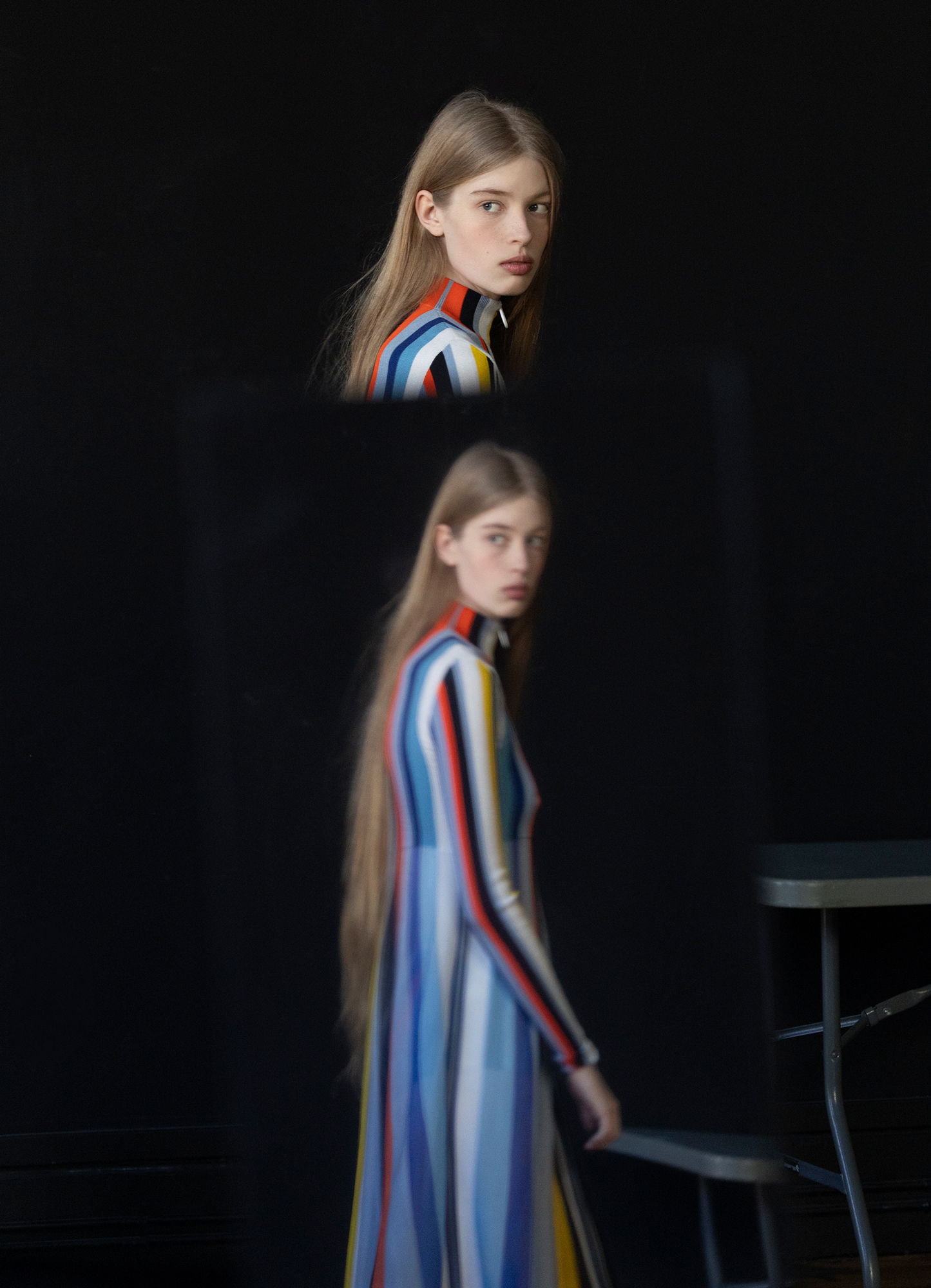
She’s so nice! And I think that’s the shift. Now there’s this emphasis on being personable.
You do kind of have to be. I don’t like being mean, so I think that fits me. I mean, I can be mean, I just don’t like it. What’s the meanest person I can think of? The Swiftologist? Is he mean? I think he’s mean. He’s probably going to see this. He’s appeared on my TikTok, and I kind of live for the drama. If you’re reading this: be nice to me, please. Or don’t. Free will is a great thing.
This probably dates me, but my generation’s was Perez Hilton.
Oh my God, wait. Can I spill some tea on Perez Hilton? For those who don’t know, there are those of us who remember. Perez Hilton was a guest judge on season three of Drag Race, and he spoiled the ending. He reported on how the show ended before any of it actually aired, basically ruining season three of Drag Race just for fun. I’ve never forgotten that.
Outside of modeling, are there other creative worlds pulling at you right now, whether that’s film, performance, design, or writing?
Yeah, actually. I don’t like saying things, because then what if I don’t do them and I look the fool? So you’ll just have to keep watching and paying attention. But there are definitely some things that will be done. Rather soon, likely.
I feel like there’s a performer within you somewhere.
Oh, that’s the reason I love my job. I love performance. I’ve done drag performances on stage: one by myself at Pattie Gonia’s [“SAVE HER!” environmental drag show,] and some with my friend Liam. Shout out to my friend Liam! I love performing. It’s part of the reason I love modeling so much.
What do you most want to prove to yourself over the next year? How are you approaching this next stage of development?
My focus is going to be being able to speak a whole sentence without interrupting or second-guessing myself, on the record. The only time I’ve been able to get a single sentence out unabashed is when I’m being mean to other people, which is probably not a good thing.
I had to go to speech therapy to figure out how to be on camera.
Oh my God, same. I had to go to speech therapy when I was little because I couldn’t say my R’s. But speaking of locking in: my focus for the next year will be locking in on myself. Specifically, the thing I would like to improve is having a presence.
Last question: what are you reading right now?
I have two books going, because I am incapable of getting anything done in a straightforward way. I’m reading *Love Is*, which is a really cutesy book, and a book called All for the Game. If you know, you know. I would say: do your research before reading that one, because it’s very hedonistic literature. Not that way. I’m not that far through it. It’s absolutely unhinged. That’s the best word I can use to describe it. Honestly, I should probably be gatekeeping this.
Gatekept. Stamped. Thank you so much for talking to me, and congrats on the year you’ve had.
Thank you, girl. This was one of the most fun interviews I’ve ever done.