Photo Isidore Montag | Courtesy of Launchmetrics Spotlight
To be frank, it started with Meji Meji. A mutual acquaintance, who happened to be a designer, was raving about her friend Rachel Ojuromi, a Lagos creative who was making waves and wanted to seriously pursue modeling. Not long after, I found myself in Lagos for a much-needed vacation and met Ojuromi in Gbagada. While there we talked deep-cut fashion references, the videos she was making with her friends, stylist Debby Fasingha and photographer Odey Ikpä, and, most importantly, what she wanted to manifest next. Who would have know that less than two months later, the new face would already be making waves at Paris Fashion Week? Yet, if you ask Ojuromi, it was destiny in the making.
In between came the viral video that introduced Ojuromi to a much wider audience: a recreation of Matthieu Blazy’s Chanel Métiers d’Art show on the streets of Lagos. Yet, “recreation” almost undersells it. Ojuromi, Fasingha, and Ikpä took the codes of Blazy’s collection and filtered them through their own world, working with thrifted pieces, clothes they already owned, and the unpredictability of Lagos itself. Ojuromi walked through it all with the kind of swagger that made audiences fall in love. The point, she explains, wasn’t simply to copy the clothes, but to ask, “How do we preserve the feeling?”
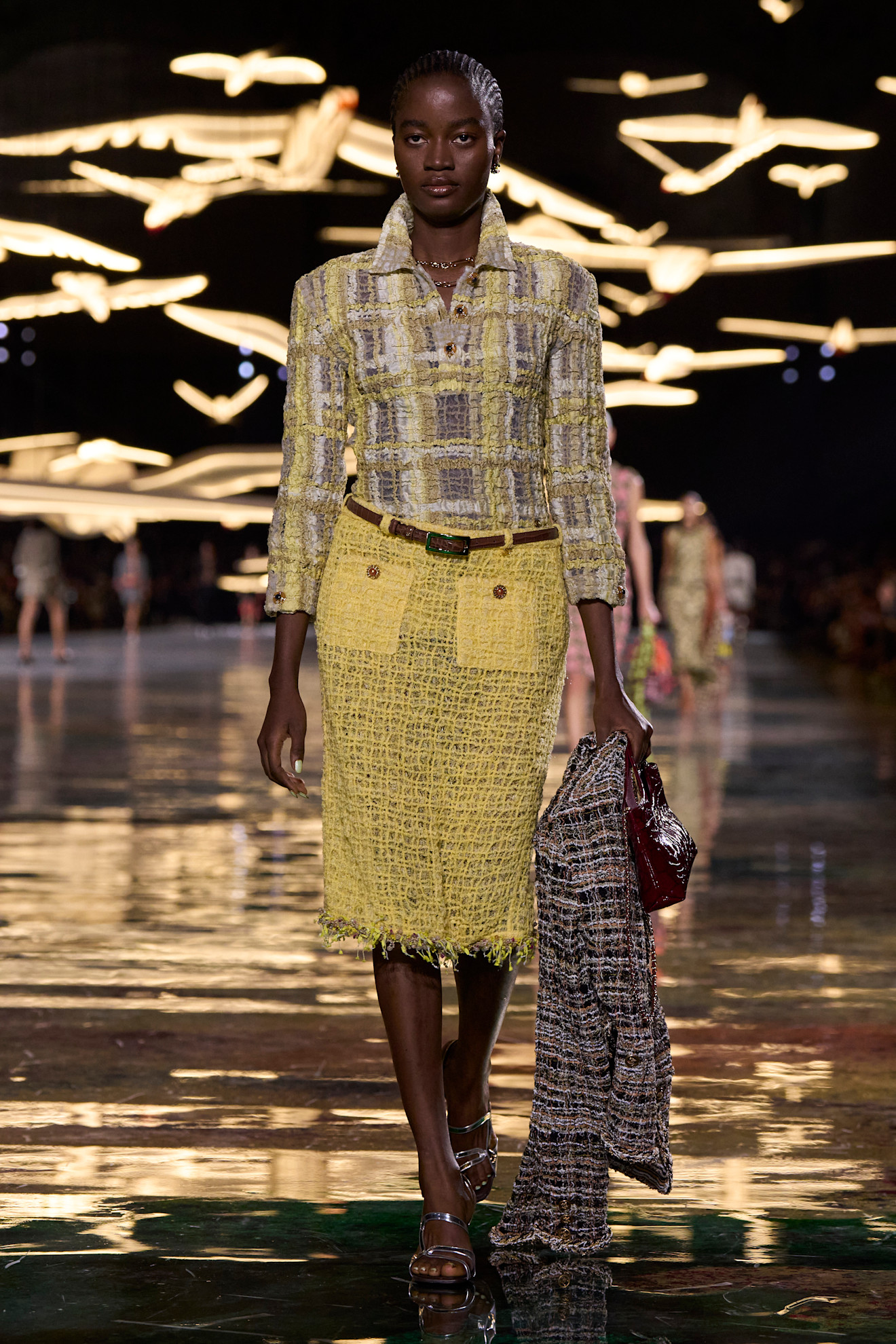
Now the model rookie has manifested her own references points, having just walked Blazy’s Chanel Spring/Summer 2027 show with that same unmistakable swagger. There’s something almost uncanny about the full-circle moment: the Chanel she studied, reinterpreted, and brought to the streets of Lagos ultimately made room for her on its own runway. A year into Blazy’s tenure, perhaps that says something about his Chanel too, and its instinct for the women shaping culture well beyond fashion’s traditional centers. Yet, modeling is only one part of Ojuromi’s story. A filmmaker and creative director before she ever considered herself a model, she founded The Process Africa after a trip to Ilorin exposed her to a generation of young creatives making work without anyone documenting the beginnings of their journeys. The platform became her answer to an industry that often starts paying attention only after someone has already gone viral. Even as her own visibility accelerates, her thinking remains collective: “Is it really success if I’m the only one in the room?” For Models.com, Ojuromi talks about the Lagos streets that became her runway, studying Prada and Mugler, finding her walk only after she started wearing heels last year, and why getting into the room means very little if she can’t bring others with her.
You’ve been creating for a while, but the videos you made in the past year introduced your world to a wider audience. Debby [Fasingha] styles, Odey [Ikpä] is behind the camera, and you’ve always been intentional about crediting them. How do you think about authorship when the work is so collaborative?
Even before the videos, when we started The Process Africa, the focus was always making sure everybody was credited properly. We noticed that someone might post an image and tag the photographer but not the model, or the model but not the photographer. In my head, I’m like, “I want to know the creative team behind this.” Very rarely is one person the brain behind an entire art piece.
With the videos, it became: “Is it really success if I’m the only one in the room?” I don’t want to enter a room and be surrounded by people I don’t know. I want to be there with my friends. Success to me means being able to bring my team with me, and beyond my team, making sure African creatives don’t always have to fight or start from scratch. Even when I see people making videos that look like mine, I’m like, “Yes, I figured out a format. Steal it. Use it. Take it!” Let’s all get in there and show them this is just the beginning. These videos aren’t the end-all, be-all of where my creativity can go. It’s simply something we realized worked, so we asked ourselves how we could pour all of ourselves into it. If someone wants the energy they see in the videos, it has to be all of us. I can’t do it alone.
That really came through in your recreation of the Chanel Métiers d’Art show. You and Debby thrifted and reworked pieces in Lagos, but it went beyond recreating the clothes. You preserved the energy Matthieu Blazy created at Chanel while filtering it through your own perspective. How did you approach that?
I think it read as something similar because it went beyond styling clothes. I had watched the show when it came out and thought it was visually interesting, but when I like a show, I sit with the articles and show notes. I need to know every thought that went into it. I learned that Matthieu chose the location because he wanted to show this convergence between people, this idea that everybody meets in the subway. To me, that is what fashion is. It’s a meeting point for people with similar or completely different interests. That’s the gift of fashion. People can decide they’re not interested in film, music, or art, but everybody has to get dressed. Matthieu took this really thoughtful conversation and made clothes out of it.
That’s also how our videos are born. We take all these things we find interesting and ask: How can we turn this into a 30-second video that someone can enjoy even if they know nothing about the reference? With Chanel, it became less about, “What are we going to wear?” and more about, “How do we preserve the feeling?” Then the clothes came. We worked with what we had and made it work. I wanted people to feel how much we cared about it.
The setting also becomes its own character. You’re shooting on the streets of Lagos, so things are happening around you constantly: people looking at you, walking into frame, life continuing. What draws you to shooting in environments you can’t completely control?
I genuinely don’t like studios. I’ve never liked them. I hate feeling trapped. If you put me in a room, I could be having fun, but the moment I find out I can’t leave, the fun has ended. The road feels like me because there’s an authenticity and unpredictability that gets the Sagittarius in me going. I’m like, “Yes, so many things can happen right now. Give me that.”
Even before these videos, we were doing shoots and music videos on the road. Major influences for me are Renell Medrano and Roy DeCarava. DeCarava photographed Harlem and showed Black people where they actually lived. Debby and I were already asking ourselves, “How can we make something that feels like a moment in time rather than something staged?” That’s how the videos feel. It’s a girl walking down the road, doing something and moving on. It isn’t, “I’m a model. Look at me.” It feels like life.
How have people in Lagos reacted? You’re creating in public without stopping everyday life around you.
At first people were like, “What’s going on?” But we constantly shoot in the same places, so now it’s almost, “Yeah, they’re back again.” Sometimes people help us. If we want to use somebody’s shop, we ask if they’re comfortable. Sometimes they’ll say, “You can use it, but I don’t want to be in the video,” and that’s completely fine. We recently had one interaction that wasn’t pleasant, but that’s part of the process. Overall, I would say it has been 99 percent positive.
The clothes are such an important part of building these worlds. When you and Debby are developing a video, what does that process look like? Are you planning weeks ahead or responding more instinctively to an idea?
Sometimes I know exactly what the styling direction should be and communicate that to Debby. Debby is a beast, to be honest. Give her two seconds and she’ll make it work, so I’m never worried about styling. With something like the Chanel video, the direction comes first. Then it becomes, “How can we find pieces that build the world we’re trying to create?”
We’ve never actually borrowed clothes from anybody. Somehow, we just have things. I have a shopping problem, but I also never throw clothes away. I still have clothes from when I was younger. I haven’t even bought clothes this year, which makes it kind of crazy that I still have clothes to wear. Somehow, we always find a way. I think when something is meant to happen, things align. Debby carries the majority of the styling, but I can communicate an idea and know she’ll make it work. If you need a good stylist, come to Africa. We have good fashion at home.
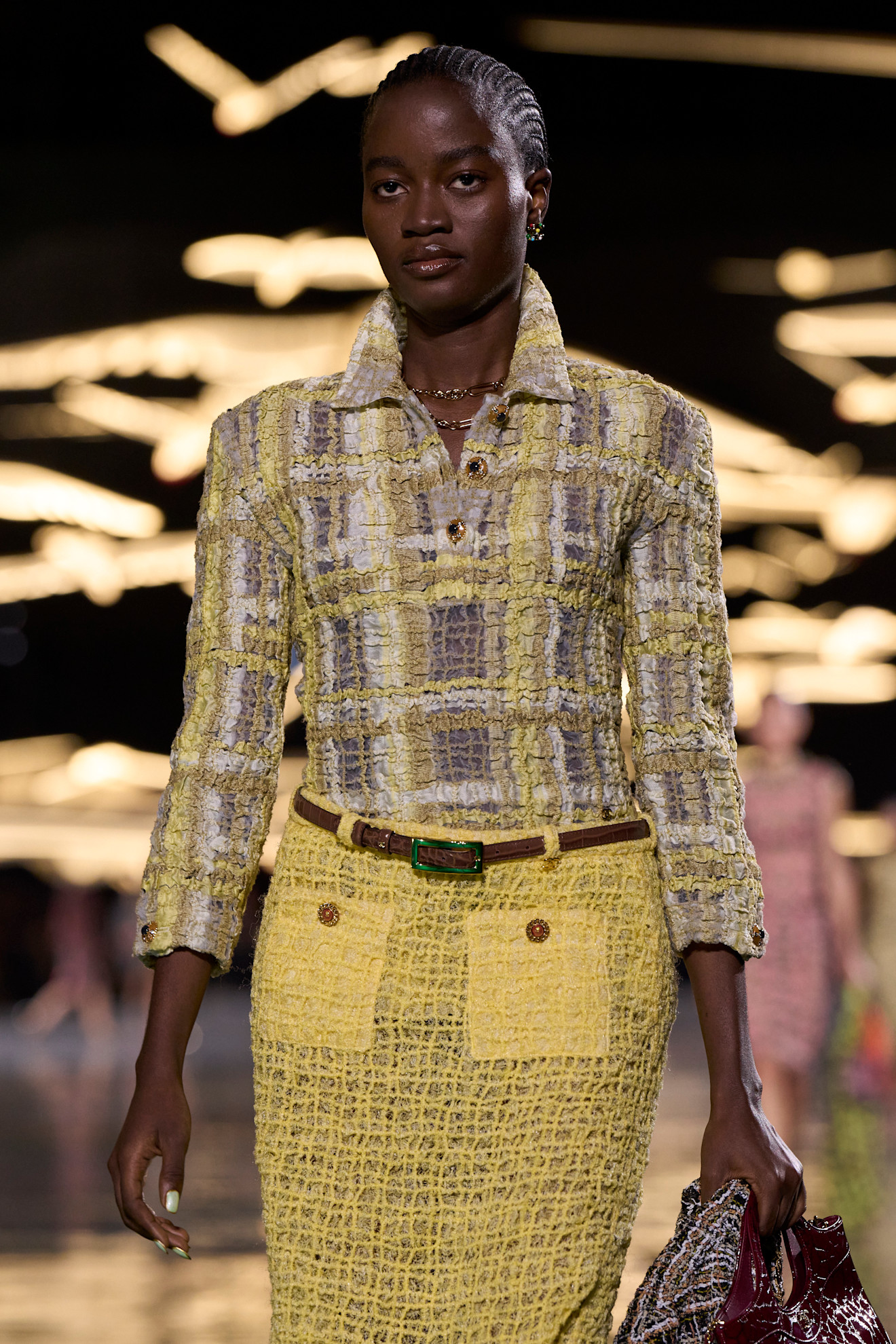
Photo Isidore Montag | Courtesy of Launchmetrics Spotlight
You’ve figured out how to communicate these ideas in under a minute, at a moment when platforms reward speed and volume. How much does the internet shape what you make? Do you see yourself eventually moving into longer-form work?
Absolutely. I went to film school. I always wanted to be a filmmaker. I want to make films, fashion films, work in consulting and creative direction—all of that. But I think there are moments in life when the world requires you to narrow in on something. That doesn’t mean you won’t explore everything else. If I need to commit six months of my life to something that allows me to eventually live the life I’ve always wanted, I’ll give it six months. When you find something that works, it can be tempting to keep doing it. But if you can make one good piece of art, you can make another. I would never limit myself to, “I have to make videos for the internet that go viral.” That limits your creativity. I met Debby and Odey offline, at my first film screening. That’s where we met, and we never stopped talking. So I want to build an audience online and offline. The moment it’s time to switch, I can switch. Bye guys. The videos are over.
Let’s talk about modeling, because the first thing that struck people about the videos was the walk. Did you have references? How did you develop it?
I don’t think anybody knows this, but I only started wearing heels last year. I didn’t perfect a walk. I realized that’s just how I walk. When the videos started, I was walking normally and people were like, “There’s this model energy.” I was like, “Oh, I didn’t know that. Thank you very much.” But I did watch a lot of fashion shows—shows from the ’90s, shows now—and you develop a feeling. To me, it’s all about feeling. When I have a direction for a video, I know what I want it to communicate, so the walk embodies that. It’s less, “I want to walk like a ’90s model,” and more, “I want to communicate this idea, and I want you to feel it without having to think too much about what’s happening.”
And the unpredictability of Lagos almost becomes part of that performance.
Exactly. You can’t say, “You’re interrupting my video,” because they’re showing life. This is a runway, and things will happen on the runway that are unpredictable. How do you adapt? You learn that the show must go on.
Before these videos, you mentioned you had already been making films and working on The Process Africa. Why did you feel the need to create that platform?
The Process Africa started after I took a trip to Ilorin. My friend hosted an event with more than 200 kids, and everybody was creating something. You’d ask someone what they did and it was, “I make music,” “I paint,” “I do this.” I kept thinking, “Who is talking about these people?” Nobody was. I went home thinking somebody had to document it. At the time, I was making YouTube videos that I treated like films, but I thought, “That work can wait. Something is happening that needs to be documented.” A lot of these people will eventually get platformed when they reach virality or stardom, but I wanted them to understand that the process—the beginning—is important too. At first it was just me, so I was publishing slowly. Then Debby offered to help, and we were able to speed things up. These people are my age. I knew nobody was talking about me, so I had to talk about them.
At what point did you decide that you should also be the person in front of the camera?
I never thought I should be the face of the idea. This is going to sound proud, but I always wanted to be seen as smart. In my head, if I was directing, I was pouring my ideas out and using somebody else as the vessel. I only got in front of the camera when we absolutely couldn’t find anybody else. Sometimes Debby would model before I would. I was not down for the modeling stuff.
However, when I started engaging with fashion history properly, I understood that the model is smart. The model is doing so much work that the people coming up with the ideas often couldn’t do themselves. The model’s job is equally important, and that gave me a greater appreciation for fashion, because I could suddenly see it from everybody’s perspective. I decided to take modeling seriously about two weeks before we started making these videos. I was also looking for something where I didn’t have to wait for somebody else to give me an opportunity. As a creative director or producer, unless you’re working on a personal project, you’re waiting for someone to book you. As a model and director, I didn’t have to wait. I had Debby and Odey working on styling and photography, and we could just make things. It became this full-circle experience.
Your knowledge of fashion history is also incredibly specific. When we first spoke, you were throwing out Chanel and Prada references and making me do my Googles. What was the show that really opened that world up for you?
Prada, Fall 1988. That was the first show where I thought, “Fashion is the greatest thing that has ever happened to the world.” It was Miuccia Prada’s first runway show, and I was like, “You genius of a woman. Where have you come from?” People might look at those clothes and say they’re simple, but when you understand the conversations she’s having through them, you realize how thoughtful it all is. My love of the Prada universe actually made me start wearing heels. I found my first pair of Prada slippers and wore those shoes for three months straight, into the ground.
There’s also a Mugler show from the ’90s with the butterfly and caterpillar [Les Insectes, S/S 1997]. Debby sent it to me, and I spent days trying to understand every reference packed into that show. I think you really enjoy fashion once you move past the clothes. Once you move past the clothes, it can feel like you’re having a conversation with the person who created them, even if that person isn’t alive anymore.
You’ve also been very intentional about platforming African creativity. As more attention comes your way, do you feel a responsibility to make sure people understand what’s happening creatively in Lagos and across the continent?
I would love for anybody who finds out about me to understand that African creativity is where it’s at. I know I’m not the end-all, be-all. I’m not going to come and save everybody. I started The Process Africa to help the people I can help, so that will always be central to my story, but the focus has to go beyond me. It can’t just be my name or me and my friends. I don’t want it to become, “If you don’t know Rachel, you can’t get what you want.” The goal is to build systems and relationships that trickle down beyond me. If you don’t know me, I should have done enough work that you shouldn’t need to.
You shouldn’t have to prove yourself to anybody. You shouldn’t have to go viral to survive and live comfortably. People in Europe and America can afford not to use the internet and still be creative. That’s what I want for every African kid, Nigerian, Ghanaian, everybody. You should be able to create without constantly performing for the internet. While the internet is central to my story now, I would also love to buy a quiet island somewhere and never have to post again.
Now you’re heading into a new fashion season, which is wild considering you only started wearing heels last year. What do you want this next chapter to look like?
It’s crazy that we’re even having this conversation because if you asked me a year ago, I would have been like, “What are you talking about? What season?” For so long, I never imagined the conversation would be about modeling. But I think that’s helpful because my goals are bigger than walking a runway. It’s about fostering relationships, talking to people and trying to build systems that can exist without me. If I’m in Nigeria, the creatives are thriving. If I’m not there, they’re still thriving. I would love to walk a runway. To be honest, I want everything. I want to walk the shows. I want to foster the relationships. But even if I’m not walking the show, the mission stays the same: making sure African creativity is platformed and remains front and center.